
The Creepy AI Job Interview
By Soozy G. Miller, CPRW, CDCC, CDP
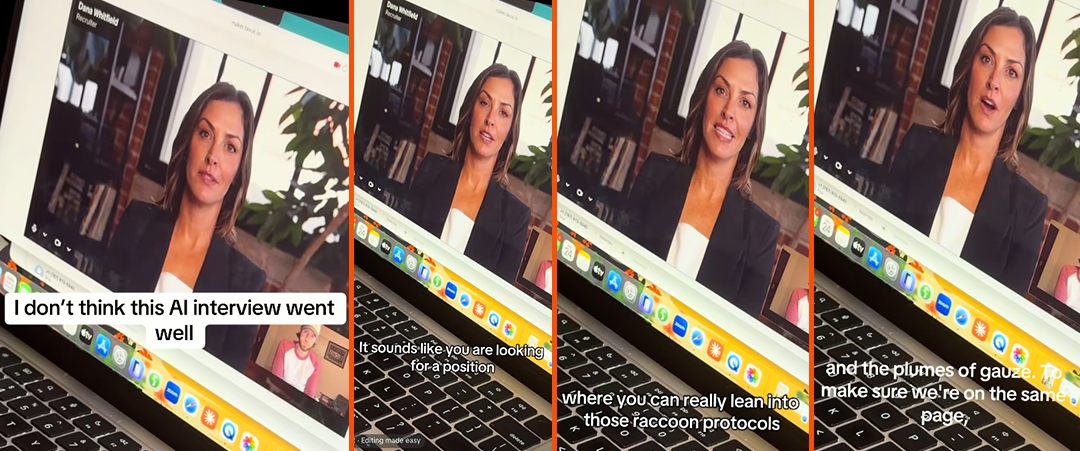
Recently, satirical content creator Graham Zip posted a viral video making fun of AI job interviews. He purposely filled the conversation with made-up words to see how the AI interviewer would respond.
Video: Graham Zip via YouTube
The conversation is obviously ridiculous, but watch the AI avatar. Listen to the monotone voice. Look at her eyes. Instead of blinking normally, her eyelids seem to slowly fall down, as though she’s exhausted from conducting too many interviews or possibly having some kind of eye muscle spasm.
C-R-E-E-P-Y.
It’s funny. Except I recently went through an AI interview myself, and his parody isn’t as far removed from the real experience as you might hope.
From time to time, I test-apply to jobs so I can experience a company’s hiring process firsthand and validate the methods I give my clients. Recently, I submitted an application and was granted an AI interview within hours.
The first email I received was essentially a “Welcome to the Company!” message.
Wow, that was easy!
Except they hadn’t actually talked to me yet. Enthusiastic message, questionable timing.
Next came another message inviting me to continue my application.
Huh. More questions?
I answered them and filled out information I had already provided. Then I reached the next step: an AI interview “experience.”
AI interviews can take several forms. An avatar might call you, an avatar might meet with you by video, or you might find yourself in a video meeting with a black screen, reading questions and responding verbally.
I got the on-screen avatar.
And I have to say, she was C-R-E-E-P-Y!
The first thing I noticed was that she was tiny, tucked down in the bottom right corner of my screen. The second thing I noticed was that her mouth moved constantly and randomly throughout the interview, definitely not according to what was being said.
Sometimes it looked like she was chewing. Other times, it looked like she was doing some sort of mouth-muscle exercise.
Weird.
I eventually tried to ignore her and just listen to the voice.
Talk about robotic.
“Interesting way of looking at that,” she monotoned.
“Thank you for that answer,” she said plainly.
Meanwhile, the entire conversation was being transcribed on the right side of my screen, where I would normally expect to see a chat. I use a very large monitor, and the type was still so small I could barely read it.
Was I supposed to use the transcription as a reference for my answers? Was I supposed to ask questions there?
I hope not!
As uncomfortable and strange as the experience was for me, and as funny as Graham Zip’s parody is, AI interviewing isn’t something job seekers can simply assume will disappear.
Employers have reasons for using it. AI interviews can make the initial screening process more standardized, allow companies to interview large numbers of applicants, and give hiring teams consistent information to use when evaluating candidates.
But there is another side to that efficiency: the candidate experience.
For a job seeker, sitting alone and talking to an artificial interviewer can feel impersonal, awkward, and even disheartening. I’ve heard many job seekers say that if they receive an AI interview request, they’ll simply ignore it and lose interest in working for the company.
Reports on candidate drop-out and no-show rates for AI interviews vary dramatically. Some put the number at around 10%, while others report rates as high as 70% or more.
Whatever the exact number, candidates are clearly struggling with this new part of the hiring process.
And I understand why. After experiencing one myself, I really understand why.
You can decide to pass on an AI interview. That’s one approach.
But if it’s a job you genuinely want, there’s another approach: learn how to interview effectively even when the person on the other side of the screen isn’t a person at all.
That means getting comfortable answering questions without the normal human feedback you rely on during an interview. No encouraging smile. No conversational back-and-forth. No interviewer nodding to let you know you’re on the right track.
The technology may be awkward. The avatar may be creepy. But you still need to communicate your experience and value clearly and confidently.
AI interviews may be clunky now, but the technology is improving quickly. Job seekers need to be prepared for the possibility that an AI interview may stand between them and the human being they ultimately want to meet.
And yes, you may need to learn how to do that while a tiny artificial woman in the corner of your screen appears to be chewing.
****
Better job. More pay. More control.
If you’re facing an AI interview and want help preparing for the experience, please contact us at Control Your Career!