
Your Resume Summary
By Soozy G. Miller, CPRW, CDCC, CDP
If your resume doesn’t include a summary section at the top, I recommend that you add one.
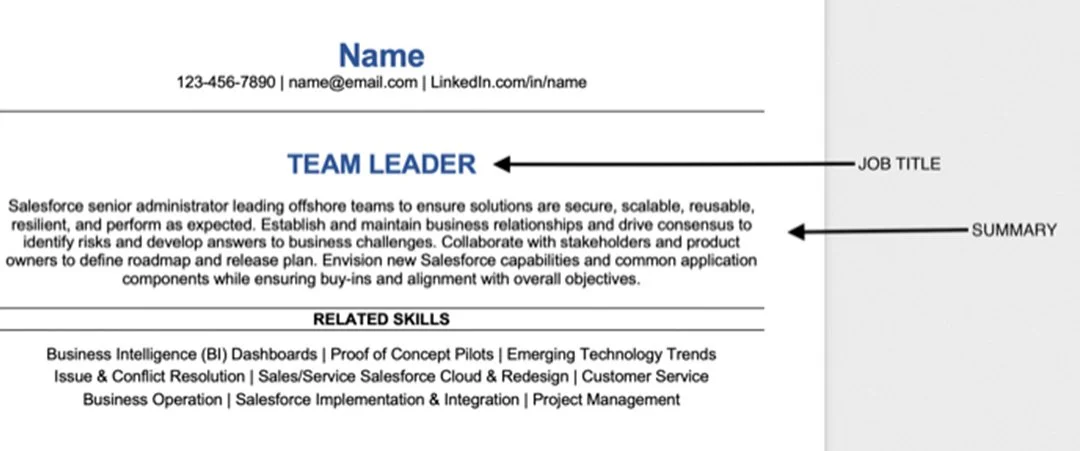
The summary goes below the title, which goes below your contact information. See my post about the importance of a title.
IMPORTANT:
Don’t add a personal objective in your summary. Nobody on the hiring team wants to see your aspirations on the resume, especially not executives. They want to know how your expertise will make the company better.
You probably think that the summary section should be a career summary or an overarching professional profile. You may have been told that the summary should be a series of statements about your abilities and strengths as a leader. A lot of experts say that your summary should be a personal branding statement. I disagree.
You want your resume to differentiate you from your competition, so the summary is meant to continue to engage the hiring team after the title. What better way to further engage the reader after the right title than to write statements that address the company’s needs?
Some people feel very awkward writing about their strengths. If so, think about it this way: You know your strengths and expertise, so how can your strengths and expertise address the company’s needs? That might feel a bit less awkward, and doing that is definitely more interesting and engaging to the resume reader than a here’s-why-you-should-hire-me paragraph.
Think about it. Which would you rather read?
I’m a seasoned professional with 10 years of experience. I lead teams to increase revenue and improve teamwork. Experience with spreadsheets, business development, and increasing sales.
OR
Award-winning accounting leader building teams that double revenue every year by chairing monthly business development meetings to hold division leaders accountable. Regularly review systems and processes to ensure optimal workflow and that customers are the priority.
You can get more specific by reading the full job posting and then using the company’s words and phrasing in your summary to address what they need. Usually you’ll find this information in the first or second paragraph of the job posting:
We’re looking for a(n) who can .
This person will .
The information is also in the first 2-3 statements under Required Skills or Position Description.
Yep, that’s right, take the information right out of that job posting. Use their words!
A bunch of clients have asked me, “Won’t the company see that I’ve plagiarized and count that against me?”
Nope.
First of all, most resumes are horribly written and difficult to decipher, so the recruiter (and the hiring team) is looking for anything on the resume that shows you understand the position and you have the skills and experience to get the job done. If you demonstrate on your resume with your title and summary that you understand what they need and you can address it, you’re way ahead of 99% of your competition.
Secondly, the more words that you use from the job posting, the better your chances of being noticed. The company may have very specific words that they use as part of the company culture. Where you might say Human Resources they might say People Resources. You and I know it’s the same thing, but the distinction is important to the company. Show that you understand their culture and that you speak their language by using their words in the summary. If you’re using AI for this, make sure that you read the content that AI gives you, because AI has a tendency toward passive, robotic language that doesn’t help you make your case.
Finally, the hiring team (and the recruiter) may not even know what the job posting says. You have no idea who wrote the job posting, so it may even have been an intern or a contractor who has no idea about the industry. You want whoever is reading your resume to understand immediately why you are the person for the job.
Do not depend entirely on AI’s interpretation, which can be off-putting. You are better than AI for gathering the important information.
The job posting is your cheat sheet. Use that cheat sheet to address the company’s needs in the summary by demonstrating your strengths and expertise that address their needs. This methodology will make your resume different and get you to the top of the pile.
****
Better job. More pay. More control.
For a resume review, please contact us at Control Your Career!